Automated Crypto Management Software: The Complete 2026 Guide
A few years ago, "crypto trading bot" meant a simple script that bought and sold based on fixed rules, a moving average crossover, a stop-loss trigger, nothing more. That era is ending. In 2026, a new category of software has taken over: AI agents that don't just execute pre-set rules, but actually observe markets, reason about what's happening, decide what to do, and act — with a wallet of their own. This shift isn't a minor upgrade. It's changing who or what actually makes the buy and sell decisions in crypto markets. Here's what's happening, why it's growing so fast, and what it takes to build this kind of software.
What Is Autonomous Crypto Trading with AI Agents?
An AI trading agent is software that can understand a goal, pull in live market and on-chain data, reason through the situation, and take action — placing trades, rebalancing a portfolio, or adjusting risk exposure with little to no human step-by-step input. This is different from a classic trading bot in one key way: a bot follows fixed if-this-then-that rules; an agent makes judgment calls. Give a bot a rule like "sell if price drops 5%," and it will always do exactly that. Give an agent a goal like "protect capital during high volatility while capturing upside," and it can weigh multiple signals price action, on-chain flows, sentiment, liquidity before deciding how to act.
Modern crypto AI agents typically combine:-
● A large language model or ML model for reasoning and pattern recognition
● Real-time access to market data, order books, and on-chain analytics
● A connected (often self-custodied) wallet to execute transactions
● Guardrails — spending limits, approval steps, risk rules — set by the human owner
What's Happening Right Now: The Trends Driving This
Shift
A few converging trends are pushing this from experimental to mainstream:-
● AI-powered trading activity is no longer a niche. Recent industry estimates put AI-driven trading bots at roughly 40–58% of daily crypto trading volume, depending on the exchange and asset class.
● Exchanges are building for agents, not just humans. Some major exchanges have released developer tools specifically designed for AI systems to place trades programmatically, rather than through a human-facing app.
● Agent tooling is maturing fast. What used to require a custom-built script now comes as a framework — wallet integration, risk limits, and reasoning loops are increasingly available off the shelf, which lowers the barrier for businesses to launch their own agent-based product.
● Investor attention has followed. AI-agent-related tokens and platforms have become one of the most closely watched categories in crypto through 2026, alongside a rise in "agent-ready" exchange infrastructure.
How Big Is the Market?

Figures compiled from industry research (Jenova AI Research, Precedence Research, and exchange/market data reported through 2026). These are third-party estimates, not guarantees — like any emerging-market projection, actual outcomes may vary. In short: even the more conservative estimates put this market growing 4–5x within the decade, and adoption inside crypto trading itself is already well past the experimental stage.
Traditional Bots vs AI Trading Agents: A Comparison

What's Driving Adoption
● Markets move faster than humans can track. Crypto trades 24/7 across hundreds of assets — no trader can monitor it all manually.
● Institutional capital is entering the space , and institutions expect systematic, data-driven execution rather than manual trading.
● Retail investors want an edge without needing to learn technical analysis or watch charts all day.
● DeFi complexity (yields, liquidity pools, lending protocols) is hard to track manually — agents can monitor and act across many protocols at once.
● Falling cost of AI infrastructure makes it commercially viable to run agents that would have been too expensive to build even two years ago.
How to Build Autonomous Crypto Trading Software: Step-by-Step

1. Research and Discovery
● Study target markets, exchanges, and asset classes the agent will trade
● Analyze competitor platforms and existing AI trading tools
● Identify the trading strategies and risk appetite the software should support
● Review regulatory requirements for the target jurisdictions
● Define success metrics for the product (performance, uptime, adoption)
2. Business Analysis
● Translate research into clear functional and non-functional requirements
● Define user roles (retail trader, institutional desk, admin/compliance)
● Map out monetization model (subscription, performance fee, per-trade fee)
● Prioritize features into MVP vs later phases
● Estimate budget, timeline, and technical resourcing
3. UI/UX Designing
● Wireframe core screens: dashboard, strategy configuration, trade history
● Design the risk-control and approval interface for transparency
● Create data-visualization views for performance and portfolio tracking
● Build clickable prototypes for stakeholder review
● Run usability testing with target users before development starts
4. System Architecture
● Design the data pipeline architecture for real-time market and on-chain feeds
● Plan the AI reasoning/decision engine and how it integrates with execution
● Architect the risk and compliance guardrail layer
● Define wallet, custody, and exchange API integration points
● Plan for scalability, security, and failover/disaster recovery
5. Core Development
● Build data ingestion pipelines for market, on-chain, and sentiment data
● Develop and integrate the AI/ML decision engine
● Implement risk guardrails, position limits, and approval workflows
● Build the execution layer connecting to wallets and exchange APIs
● Develop the dashboard, reporting, and alerting features
6. QA and Testing
● Backtest strategies against historical market data
● Run simulated/paper trading before live deployment
● Perform security testing and penetration testing on wallet and execution layers
● Load-test the system for high-volatility, high-volume conditions
● Validate compliance and audit-logging accuracy
7. Deployment
● Deploy to production infrastructure with monitoring in place
● Migrate from paper trading to live trading with conservative limits
● Set up real-time alerting for system and trading anomalies
● Confirm regulatory and compliance sign-off for the target markets
● Prepare rollback and incident-response plans before full launch
8. Post-Launch Support
● Monitor performance, uptime, and model accuracy continuously
● Retrain or fine-tune AI models as market conditions evolve
● Patch security vulnerabilities and update dependencies
● Roll out new features and exchange/chain integrations over time
● Provide ongoing customer and compliance support
Technology Stack

10 Core Features to Include
1. Real-time market & on-chain data feeds — price, volume, liquidity, whale activity
2. AI-driven strategy engine — reasoning-based decision making, not just fixed rules
3. Configurable risk guardrails — position limits, stop-losses, daily loss caps
4. Human-in-the-loop approval mode — optional manual confirmation before execution
5. Multi-exchange / multi-chain support — trade across platforms and blockchains
6. Secure wallet integration — self-custody or institutional-grade custody options
7. Backtesting & simulation — test strategies against historical data before going live
8. Performance analytics dashboard — P&L tracking, win rate, drawdown metrics
9. Alerting & notifications — real-time updates on trades, anomalies, and risk events
10. Compliance & audit logging — full transaction history for regulatory reporting
How Much Does Software Development Cost?

What Factors Impact the Cost
● Number of exchanges/blockchains supported — each integration adds development and testing time
● Complexity of the AI model — a fine-tuned custom model costs more than an API-based LLM integration
● Custody model — self-custody vs institutional custody (with HSMs, multi-sig) significantly changes security engineering effort
● Regulatory requirements — AML/KYC and jurisdiction-specific compliance add scope
● Backtesting and simulation depth — robust historical testing infrastructure takes real engineering time
● Real-time performance needs — low-latency execution requires more infrastructure investment
● UI/UX and reporting complexity — institutional dashboards with detailed analytics cost more than a simple app
Industries That Need This
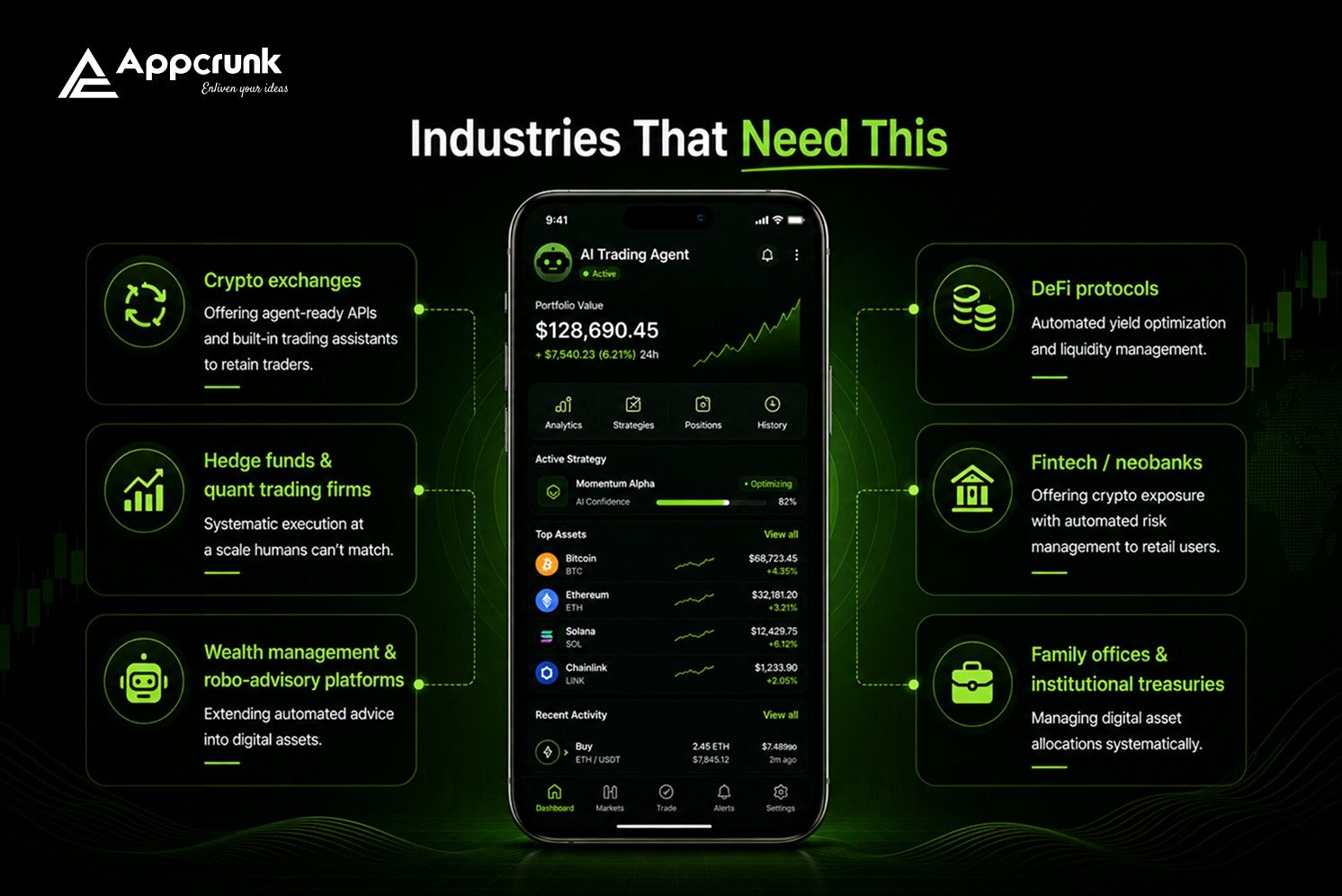
● Crypto exchanges — offering agent-ready APIs and built-in trading assistants to retain traders
● Hedge funds & quant trading firms — systematic execution at a scale humans can't match
● Wealth management & robo-advisory platforms — extending automated advice into digital assets
● DeFi protocols — automated yield optimization and liquidity management
● Fintech / neobanks — offering crypto exposure with automated risk management to retail users
● Family offices & institutional treasuries — managing digital asset allocations systematically
Benefits of AI-Powered Crypto Trading Software
● 24/7 market coverage — no missed opportunities or risks while humans sleep
● Faster reaction to market events — agents can process and act on data in seconds
● Reduced emotional decision-making — systematic execution instead of panic selling or FOMO buying
● Scalability — one system can monitor and trade across many assets and markets simultaneously
● Better risk management — automated guardrails enforce discipline consistently
● Data-driven strategy improvement — continuous learning refines performance over time
Conclusion
AI agents are moving crypto trading from something people do to something they supervise . That shift brings real opportunity — faster execution, broader market coverage, and more disciplined risk management — but it also raises the stakes on getting the engineering right: strong guardrails, transparent reporting, and solid custody and compliance design aren't optional extras, they're what separates a trustworthy product from a liability. For businesses — exchanges, fintechs, funds, or DeFi platforms — building this kind of software now means positioning early in a market that's still forming its standards. Whether you're exploring a simple AI-assisted trading dashboard or a full autonomous agent with institutional-grade custody, the build starts with the same first step: clearly defining the strategy, the risk boundaries, and the level of autonomy you're comfortable giving the software.
Frequently Asked Questions (FAQs)
1. Is autonomous AI crypto trading legal?
In most jurisdictions, yes — but regulations vary and are evolving quickly, especially around custody, AML compliance, and disclosures. Legal review specific to your target markets is essential before launch.
2. How is an AI trading agent different from a regular trading bot?
A traditional bot follows fixed rules. An AI agent reasons across multiple data sources and can adapt its
approach as conditions change, within the guardrails it's given.
3. Can AI trading agents guarantee profits?
No. Like any trading system, they manage risk and process information faster than humans, but they operate in genuinely unpredictable markets and can lose money.
4. How much control does the user retain?
This is fully configurable — from fully autonomous execution to a mode where every trade requires manual approval before it executes.
5. What's the biggest technical risk in building this kind of software?
Security and guardrail design. A poorly guarded agent with wallet access can execute costly mistakes at machine speed, so risk limits and testing matter as much as the AI model itself.
6. How long does it take to build a basic version?
A focused MVP with core AI-assisted features typically takes 8–12 weeks; a full institutional-grade platform can take 6–12 months.
7. Do I need my own AI model, or can I use existing APIs?
Most products start with API-based LLMs (like GPT, Claude, or Gemini) combined with custom quantitative models, then move to fine-tuned or proprietary models as the product matures.
Want to explore building AI-powered crypto trading or investment software for your business?
Talk to Appcrunk's AI & blockchain team to scope your project.
Written By- Kirat Kaur
Construction Project Management Software in 2026 Top Solutions & How to Build Your Own
Why We Build Sport-Club Apps Differently From Court to Code
Generative vs Agentic AI The Next Evolution in AI Technology
How a Fintech App Development Company Can Boost Your Business Growth
Build Smart Taxi Apps Using AI Technology
How AI Is Changing Healthcare App Development
Why AI Matters in Grocery App Development
How AI Improves Real Estate Mobile Apps
Innovative AI Fitness App Development Solutions
Fintech App Development with Advanced AI Solutions
Custom OTT App Development with AI for Entertainment Platforms
Grocery Delivery App Development Solutions with AI
Home Services App Development with Intelligent AI Features
Next Generation Taxi and Transportation Apps Powered by AI
Transforming Travel Experiences with AI-Driven Hotel and Tourism Apps
AI-Driven Fitness App Development for Smart Wellness
E-Commerce App Development Using AI Technology
Smart Real Estate App Development Using AI
Smart eLearning App Development Services with AI Features
AI Healthcare Solutions Transforming Medical Services
Building Smart and Secure Social Media Apps with AI
Food Delivery Apps with Intelligent AI Features
AI-Enhanced Dating Applications The Future of Intelligent and Significant Connections
Adobe Joins Forces With ChatGPT A New Era of AI-Powered Creativity
How We Recovered from a Server Compromise RondoDox Botnet Crypto Mining Malware the React CVE-2025-55182-66478 Exploit
Boost Your Coffee Shop App with These Must-Have Features
Must-Have Features in Your Food Delivery App for 2025 Enhancing User Experience and Efficiency
Flutter vs React Native
Mobile App Security
Challenges in Mobile Application Development


Founded in 2018, Appcrunk Technologies specializes in AI-powered mobile and web development. Our skilled team transforms ideas into smart digital products by combining innovation, creativity, and the latest technologies to deliver impactful results.
Copyright © Appcrunk 2026


